Utility and Value
Definition (Primary-Source)
-
Utility: Jeremy Bentham (An Introduction to the Principles of Morals and Legislation, 1789) defined utility as:
“That property in any object, whereby it tends to produce benefit, advantage, pleasure, good, or happiness … or to prevent the happening of mischief, pain, evil, or unhappiness.” -
Value: Adam Smith (The Wealth of Nations, 1776) distinguished between:
“Value in use” (the usefulness of an object) and “value in exchange” (the power of purchasing other goods).
Introduction
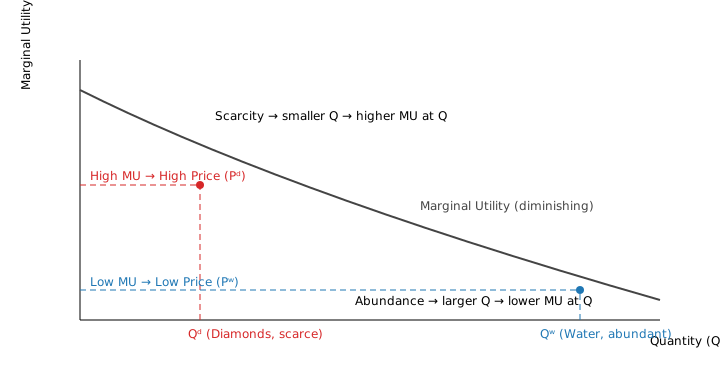
Why is water, essential for life, often cheap… while diamonds, which are non-essential, are expensive? This is the classic paradox of value. Economists resolved this puzzle using the concepts of utility and value.
Explanation
-
Utility
-
Satisfaction or pleasure derived from consuming a good or service.
-
Types:
-
Total Utility (TU): Overall satisfaction.
-
Marginal Utility (MU): Extra satisfaction from one more unit.
-
-
Law of Diminishing Marginal Utility: Each additional unit consumed gives less satisfaction.
-
-
Value
-
Value in use: Practical importance (e.g., water for survival).
-
Value in exchange: Market worth (e.g., diamonds fetch a high price).
-
Prices in markets reflect exchange value, not just usefulness.
-
Together, utility explains consumer demand, while value explains pricing and the trade-offs associated with it.
Diagram: