
Scarcity and Choice
Definitions
“Economics is the study of how society manages its scarce resources.” — Paul A. Samuelson, Economics (1948)
“Scarcity is the condition in which human wants are unlimited, but the resources to satisfy those wants are limited.” — Lionel Robbins, Essay on the Nature and Significance of Economic Science (1932)
Explanation
Scarcity is the starting line of every economic story. Resources—time, money, land, skills, machines—are finite, while the list of things we want keeps growing. That mismatch forces choices.
Picture yourself with two evening hours. Option A: revise for tomorrow’s test. Option B: do a quick freelance job. Option C: meet friends. You can’t do all three well. Whatever you pick, you give up the next best option. That forgone best alternative is the essence of economic thinking that will follow you into pricing, budgeting, hiring, investing—everywhere.
Scale it up to governments. A finance ministry can allocate funds to expressways, public hospitals, or clean energy initiatives. Each choice means saying “not now” to something valuable. During the COVID-19 pandemic, leaders faced the sharpest version of this dilemma: protect health through lockdowns (and harm jobs) or keep activities open (and accept higher health risks). Different countries made different choices; the outcomes reflected those trade-offs.
Real-World Case: Semiconductor Shortage (2020–2022)
A global shortage of microchips forced carmakers to make hard choices. They had limited chips but many models to produce. Most companies prioritized high-margin vehicles, such as SUVs and luxury cars, while delaying or canceling production of small, affordable models. This demonstrated scarcity in action: scarce resources (chips) necessitated trade-offs (luxury cars vs. mass-market cars), and the opportunity cost was the forgone production and revenue from the skipped model (Reuters).
Diagram
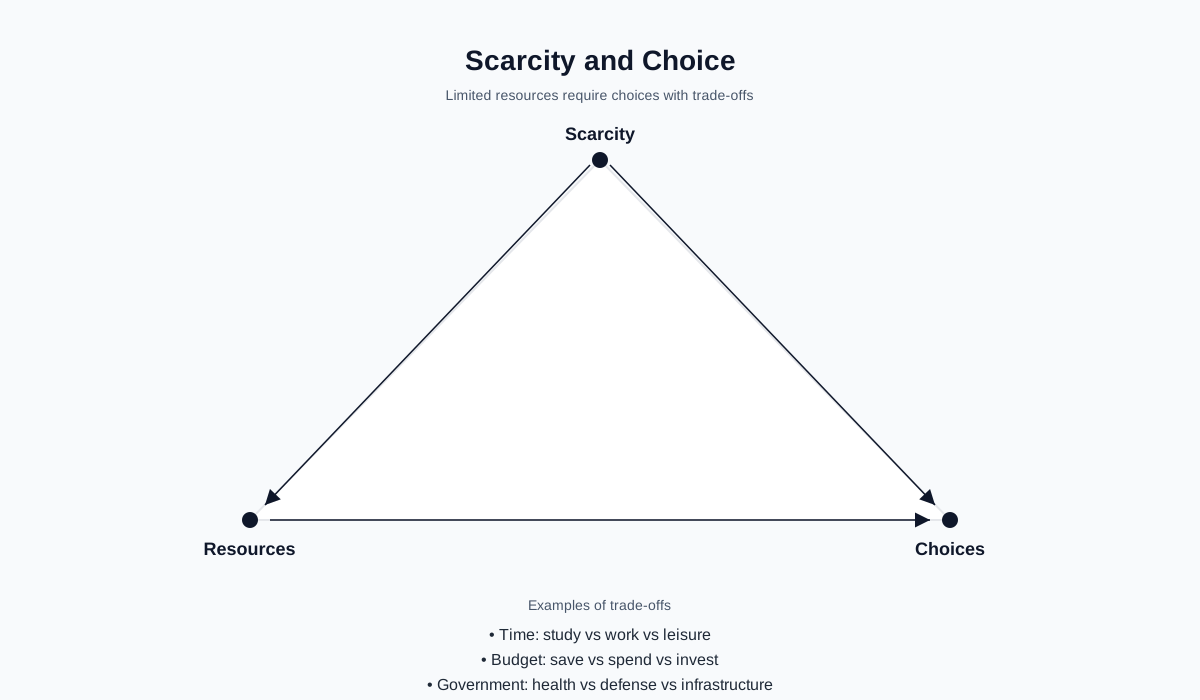
Explanation of the Diagram
-
At the top is Scarcity — the problem that resources are limited.
-
This leads to two key concepts: Resources (land, labor, capital, and time) and Choices (decisions about how to utilize them).
-
Between Resources and Choices lies the trade-off: using resources for one purpose means giving up another.
-
At the bottom are real-life examples of trade-offs: study versus work versus leisure, save versus spend versus invest, and national priorities such as health, defense, and infrastructure.
-
The triangle shows that scarcity creates the need for choice, and choice always involves trade-offs.
Key Takeaways
-
Scarcity exists because resources are limited, but wants are unlimited.
-
Every choice has a trade-off; the opportunity cost is the next best alternative forgone.
-
Scarcity forces the three central economic questions: what to produce, how to produce, and for whom.
-
Real-world problems, such as chip shortages or energy crises, highlight that scarcity is not abstract—it drives critical decisions.