
Production Possibility Curve (PPC)
Definition
Paul Samuelson (1948) introduced the Production Possibility Frontier/Curve in modern economics:
“The production-possibility frontier (or curve) represents all possible combinations of goods that can be produced when all resources are fully and efficiently employed, given the state of technology.”
Introduction
Think of your Sunday morning. You have 2 hours and must split them between:
-
Watching cricket highlights, or
-
Cooking a big breakfast.
You can’t do both fully. The PPC is a graph that shows such trade-offs when resources are fixed. It’s the “menu” of maximum choices available to a society.
Explanation
-
On the curve: Resources are utilized fully and efficiently.
-
Inside the curve: Inefficiency — unemployment, waste, or underutilization.
-
Outside the curve: Currently impossible unless more resources or technology become available.
-
Shape: Usually concave (bowed out) because of the law of increasing opportunity cost.
-
Shifts:
-
Outward: growth, new tech, or more resources.
-
Inward: disasters, wars, or resource depletion.
-
Diagram: Concave PPC with Key Points
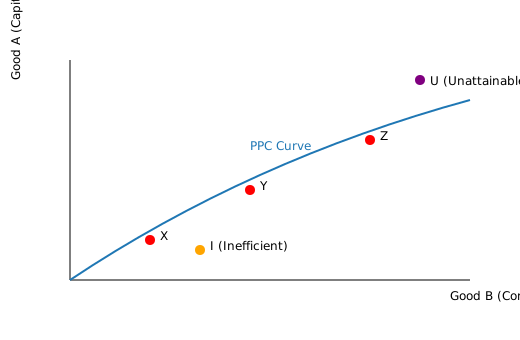
Diagram Explanation
-
X, Y, Z: Efficient use of resources on the PPC.
-
I (Inside): Resources wasted or unemployed.
-
U (Outside): Beyond current capacity.
-
Curve’s concave shape shows rising opportunity cost when switching resources.
Key Takeaways
-
PPC shows the maximum possible output combinations.
-
Illustrates scarcity, choice, efficiency, and opportunity cost.
-
Inside curve = inefficient, on curve = efficient, outside = unattainable.
-
Shifts in the PPC = economic growth or decline.
Real-World Case
Japan’s Resource Allocation (Post-WWII Industrialisation)
-
Limited resources forced Japan to choose between consumer goods and capital goods.
-
The country prioritised capital goods (machinery, steel, technology).
-
This shift in Japan’s PPC outward over time enabled its rise as a leading industrial economy.
Reference: Johnson, Chalmers (1982), MITI and the Japanese Miracle.