
Opportunity Cost & the Production Possibility Frontier (PPF)
Definitions
“Opportunity cost is the value of the next-best alternative forgone when a choice is made.” — Investopedia
“The Production Possibility Frontier (PPF) shows the maximum feasible output combinations of two goods or services that an economy can achieve when all resources are fully and efficiently utilized.” — Corporate Finance Institute (CFI)
Explanation
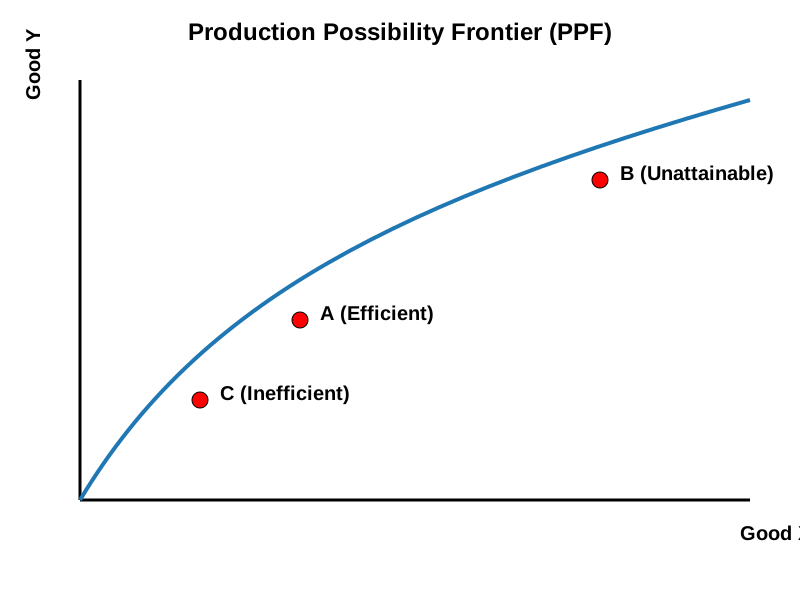
At its core, opportunity cost is about recognizing that resources are scarce and every decision excludes another possibility. The PPF is the most common way economists illustrate this: it maps the maximum combinations of two goods an economy can produce given its resources and technology.
-
Points on the curve: efficient use of all resources.
-
Points inside the curve: inefficiency—resources are underutilized.
-
Points outside the curve: unattainable with current resources.
By moving along the curve, society confronts trade-offs. Gaining more of one good requires sacrificing some of the other. The slope of the PPF at any point reflects the opportunity cost of that choice.
Real-World Case: Agriculture vs. Biofuel Crops (2007–2008)
During the 2007–2008 food crisis, several countries redirected farmland to grow crops like corn for biofuel production. This decision reduced the availability of food crops and contributed to global price spikes.
-
Resources: land, fertilizer, and labour were scarce.
-
Choice: produce biofuels for energy security.
-
Opportunity cost: fewer food crops, rising global hunger risks.
-
Lesson: When resources are reallocated, one sector grows at the cost of another.
This event demonstrates the PPF in practice: biofuels moved outward, but food supplies declined, highlighting the unavoidable nature of trade-offs.
Source: Food and Agriculture Organization of the United Nations —
“The State of Food and Agriculture 2008”
Diagram
Key Takeaways
-
Opportunity cost refers to the next-best alternative that is forgone.
-
The PPF demonstrates efficient, inefficient, and unattainable output levels.
-
Moving along the PPF = making trade-offs.
-
The PPF shifts outward with technological progress, better skills, and capital accumulation.
-
Real-world case: The diversion of farmland to biofuels revealed opportunity costs on a global scale—food versus energy security.