
Movement vs. Shift in the Demand Curve
Definition
Alfred Marshall, in Principles of Economics (1890), distinguishes movements along a demand curve (caused by changes in the good’s own price, ceteris paribus) from shifts of the demand curve (caused by changes in other conditions like income, prices of related goods, or tastes). (Marshall, Alfred. Principles of Economics)
Introduction
Picture movie tickets. If the cinema cuts ticket price from ₹300 to ₹200 for one weekend, more people go—that’s a movement along the same demand curve (price changed). But if, over time, people fall in love with OTT streaming and prefer home viewing, overall demand for cinema tickets changes at every price—that’s a shift of the demand curve.
Explanation
-
Movement along the demand curve (extension/contraction):
• Trigger: Own price changes (all else constant)
• Effect: Slide up or down the same curve (e.g., (P₁,Q₁) → (P₂,Q₂) on D₀) -
Shift of the demand curve (increase/decrease):
• Trigger: Non-price determinants change (income, tastes, substitutes/complements’ prices, population, expectations, policy)
• Effect: The entire curve moves right (increase in demand) or left (decrease), creating a new curve (D₁ or D₂) -
Quick test: Ask, “Did own price change?” If yes → movement. If not, but the quantity demanded changes → shift.
Diagram: Movement vs. Shift (Legend on Right, Zero Overlap)
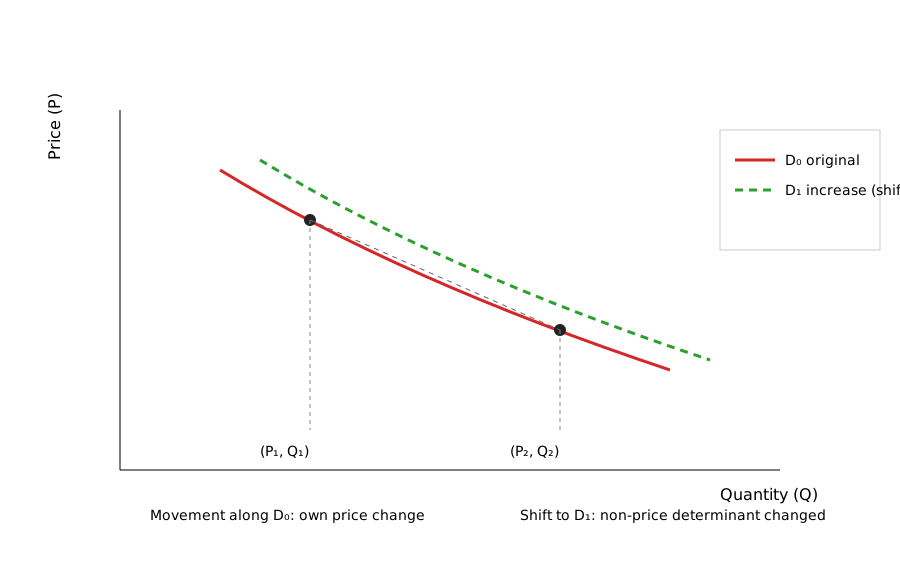
Diagram Explanation
The dotted path between the two black points indicates movement along D₀ resulting from a price change. The green dashed curve (D₁) sits to the right of D₀—an increase in demand at every price—due to a non-price determinant (e.g., a positive change in tastes or income).
Real-World Case
Cinema Tickets vs. OTT Streaming
• Weekend discount on tickets → movement along D₀ (lower price, higher quantity demanded for that weekend).
• Rise of OTT platforms (better content library, convenience) → shift right or left in cinema demand depending on market; typically a leftward shift for theatres over time at any given ticket price.
Reference: Statista. OTT video market in India – key figures
Key Takeaways
-
Own price change → movement along the same curve.
-
Non-price determinants → shift to a new curve (right for increase, left for decrease).
-
Use the quick test: price change = movement; otherwise (with quantity changed) = shift.
-
Keep curves parallel in simple pedagogy to avoid visual confusion; label shifts with a clear legend.