
Market Equilibrium
Definition
Léon Walras, in Éléments d’économie politique pure (1874), explained equilibrium as the point where the plans of buyers and sellers are mutually compatible: the price at which quantity demanded equals quantity supplied. (Walras, Léon. Éléments d’économie politique pure)
Introduction
Imagine a weekly vegetable market. At ₹40 per kilogram, there are too many buyers for tomatoes compared to what sellers bring — a shortage! At ₹100 per kilo, sellers bring in heaps, but buyers vanish — a surplus! Somewhere in between, there’s a price (say ₹70) where the amount buyers want matches what sellers supply. That “sweet spot” is market equilibrium.
Explanation
-
Equilibrium Price (P*)
The price at which demand equals supply. -
Equilibrium Quantity (Q*)
The traded quantity at P*. -
Disequilibrium
• At price above P* → surplus (excess supply).
• At price below P* → shortage (excess demand). -
Adjustment Mechanism
Competition pushes prices toward equilibrium:
• Surplus → sellers cut price → demand rises, supply falls → back to P*.
• Shortage → buyers bid up price → supply rises, demand falls → back to P*.
This concept underpins how decentralized markets “self-correct” under competitive conditions.
Diagram
-
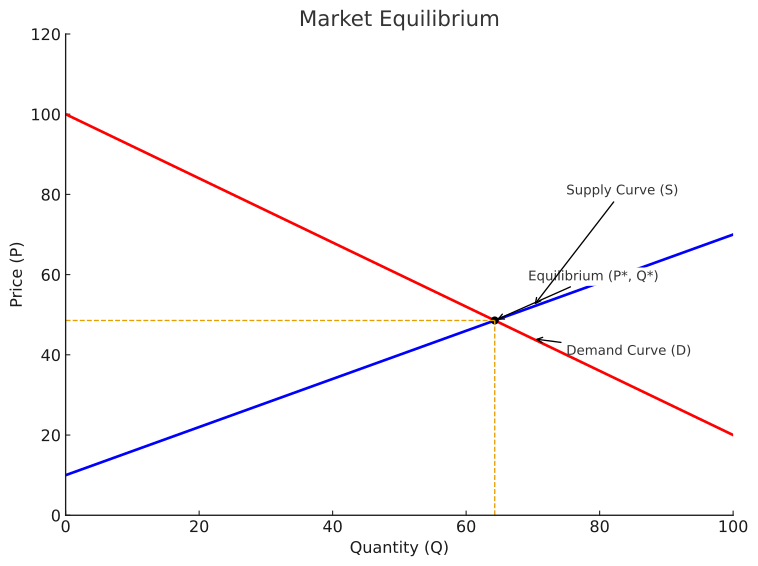
The Demand curve (D) slopes downward.
-
The Supply curve (S) slopes upward.
-
They intersect at the equilibrium point (P*, Q*), where market demand equals market supply.
Real-World Case
Smartphone Pricing in India
When a new budget model is launched at a too-high price, units pile up in warehouses (surplus). Retailers slash prices until demand catches up — reaching equilibrium. Conversely, when a hot model is underpriced, stocks vanish instantly (shortage) and prices rise in resale markets.
Reference: Counterpoint Research. India Smartphone Market Report 2023
Key Takeaways
-
Market equilibrium occurs where quantity demanded = quantity supplied.
-
Prices above equilibrium create surplus; prices below equilibrium create shortage.
-
In competitive markets, forces of supply and demand push prices toward equilibrium.
-
Real markets often fluctuate around equilibrium but the principle is the anchor.