
Economic Systems (Capitalism, Socialism, Mixed Economy)
Definition
-
Capitalism: Adam Smith (1776) in The Wealth of Nations — “Every man, as long as he does not violate the laws of justice, is left perfectly free to pursue his own interest his own way.” This laid the foundation of the capitalist system: private ownership, markets, and self-interest.
-
Socialism: Karl Marx & Friedrich Engels (1848) in The Communist Manifesto — “The theory of the Communists may be summed up in the single sentence: Abolition of private property.” Socialism emphasizes collective ownership and equality.
-
Mixed Economy: Paul Samuelson (1948) described it as an economy that combines private markets with government intervention to strike a balance between efficiency and social welfare.
Introduction
Every society needs an economic system — a way to answer the three fundamental problems: What to produce? How to produce? For whom to produce? Different thinkers proposed different systems:
-
Smith championed freedom of markets.
-
Marx pushed for state ownership and equality.
-
Samuelson and modern economists recognised hybrids.
Today, most nations run on some form of mixed economy.
Explanation
1. Capitalism
-
Ownership: Private individuals own resources.
-
Decisions: Made through market forces (supply and demand).
-
Pros: Efficiency, innovation, consumer choice.
-
Cons: Inequality, exploitation risk, and cycles of boom and bust.
2. Socialism
-
Ownership: The State owns key resources.
-
Decisions: Central planning replaces markets.
-
Pros: Equality, focus on welfare.
-
Cons: Inefficiency, lack of incentives, bureaucracy.
3. Mixed Economy
-
Ownership: Both private and state.
-
Decisions: Markets allocate, but the state intervenes where markets fail.
-
Pros: A balance of efficiency and equity.
-
Cons: Risk of corruption, policy tug-of-war.
Diagram: Three Economic Systems
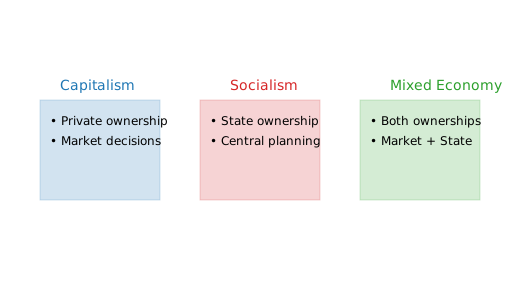
Diagram Explanation
The three boxes illustrate the spectrum of systems: capitalism (market-led), socialism (state-led), and mixed economy (blended). Most real-world economies fall somewhere in the middle of the green box.
Key Takeaways
-
Capitalism = market freedom, but risks inequality.
-
Socialism = equality via state control, but risks inefficiency.
-
Mixed economy = blend, aiming for balance.
-
No system is “perfect”; each society adjusts according to culture, history, and priorities.
Real-World Case
India’s Transition (1947–1991–Present)
-
Post-independence: Followed socialism-inspired central planning (Nehruvian model).
-
The 1991 reforms, characterized by liberalization, privatization, and globalization (LPG), shifted India toward capitalism.
-
Today, India is a mixed economy — markets dominate, but the state still plays a strong role in infrastructure, banking, and welfare.