
Determinants of Supply
Definition
Alfred Marshall, in Principles of Economics (1890), notes that the amount producers bring to market depends not only on the commodity’s own price but also on other conditions such as input costs, technology, the number of sellers, and expectations—so supply is a function of multiple determinants. (Marshall, Alfred. Principles of Economics)
Introduction
Imagine you run a chai stall. Even if your selling price stays the same, your willingness to supply can change because tea leaves got cheaper (inputs), you bought a faster kettle (technology), or three new chai stalls opened nearby (more sellers). These non-price factors shift the entire supply curve.
Explanation
Major determinants that shift supply (holding a good’s own price constant):
-
Input Prices (costs of production)
• Inputs ↓ → costs ↓ → supply ↑ (right shift)
• Inputs ↑ → costs ↑ → supply ↓ (left shift) -
Technology & Productivity
Better methods/equipment raise output at every price → supply ↑. -
Number of Sellers (market size)
More firms → greater total supply; fewer firms → lower supply. -
Prices of Related Goods (in production)
If tomatoes become far more profitable, a farmer may shift land from chillies to tomatoes, reducing chilli supply. -
Taxes, Subsidies, and Regulation
Subsidy → supply ↑; per-unit tax or costly compliance → supply ↓. -
Expectations about Future Prices
Expect higher future price → withhold now (current supply ↓); expect lower future price → sell more now (current supply ↑). -
Natural/Random Factors
Weather, pests, strikes, or logistics shocks can swing supply.
Schematic (read: “Q-s is a function of …”):
Qˢ = f(P; input costs, technology, number of sellers, related output prices, policy, expectations, shocks)
• P (own price) → movement along the curve; everything after the semicolon → curve shifts.
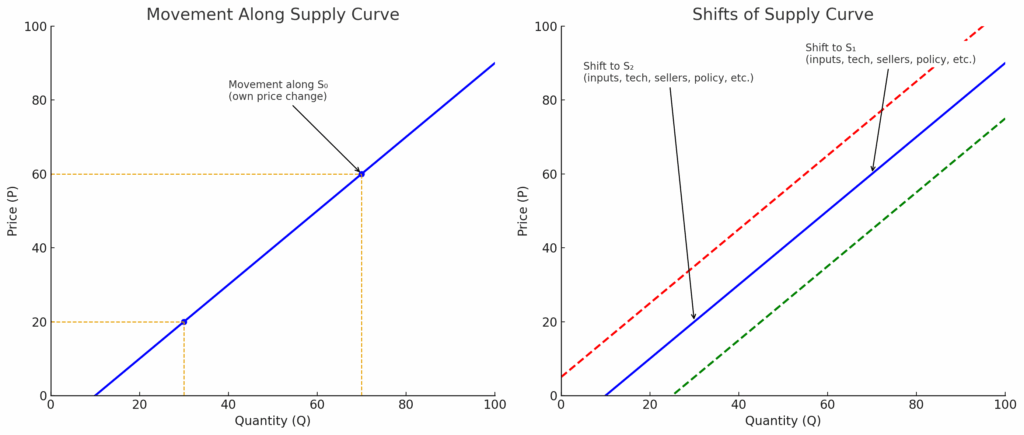
Diagram: Supply Shifts
Diagram Explanation
-
Left panel → Movement along S₀: shows own price change from (P₁, Q₁) to (P₂, Q₂).
-
Right panel → Shifts of Supply: curves move from S₀ → S₁ (right) or S₀ → S₂ (left) when determinants like inputs, technology, number of sellers, or policies change.
Real-World Case
Solar Panel Manufacturing (India)
A production-linked incentive (PLI) programme and cheaper input modules increased domestic capacity and efficiency, shifting the supply curve to the right (resulting in more output at each price). Conversely, spikes in polysilicon prices or freight costs would shift the supply curve to the left.
Reference: International Energy Agency. Renewables 2023
Key Takeaways
-
Own price → movement along the supply curve; determinants → supply curve shifts.
-
Input costs, technology, the number of sellers, related output prices, policy, expectations, and shocks are the key drivers.
-
For pedagogy, keep curves parallel and use a legend—students grasp direction without clutter.