
Determinants of Demand
Definition
Alfred Marshall, in Principles of Economics (1890), explained that the amount demanded depends not only on the commodity’s own price (ceteris paribus) but also on other conditions—such as income, prices of related goods, and tastes—so demand is a function of multiple determinants. (Marshall, Alfred. Principles of Economics)
Introduction
Ever notice how iced coffee sells out on hot days even if the price doesn’t change? That’s because non-price factors (weather, tastes, income, substitutes, etc.) shift the entire demand curve. Price changes move you along a given curve; determinants shift the curve to a new position.
Explanation
Major determinants that shift demand (holding a good’s own price constant):
-
Income (Y)
• Normal goods: income ↑ → demand ↑
• Inferior goods: income ↑ → demand ↓ -
Prices of Related Goods
• Substitutes (tea ↔ coffee): price of tea ↑ → demand for coffee ↑
• Complements (smartphones ↔ data plans): price of phones ↓ → demand for data plans ↑ -
Tastes & Preferences
Trends, health awareness, brand perception, seasons (e.g., athleisure boom, festive sweets). -
Population & Demographics
More buyers or a new age/urban mix can raise or lower demand. -
Expectations
Expected future price ↑ or shortage news → demand today ↑. -
Information & Advertising
Viral reviews or influencer buzz can lift demand independent of price. -
Government & Institutions
Taxes, subsidies, and regulation (e.g., subsidies on LEDs) shift demand.
Schematic (read: “Q-d is a function of …”):
Qᵈ = f( P ; Y, P_sub, P_comp, tastes, population, expectations, policy )
• P (own price) → movement along the curve.
• Everything after the semicolon → curve shifts.
Diagram: Demand Shifts (no overlap, ample padding)
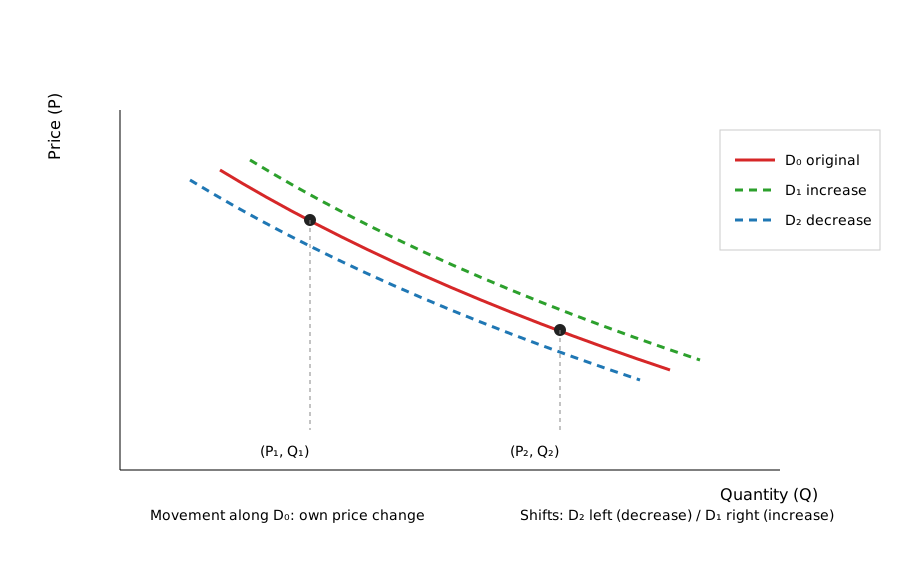
Diagram Explanation
• Moving from (P₁, Q₁) to (P₂, Q₂) along D₀ = own price changed.
• Jumps from D₀ → D₁ (right) or D₀ → D₂ (left) = a determinant changed (income, substitutes/complements, tastes, etc.).
Real-World Case
EV Scooters vs. Petrol Scooters (Urban India)
A combination of higher petrol prices (substitutes), state subsidies (policy), and improved models/brand pull (tastes) has shifted demand to the right for electric scooters, while softening demand for some petrol models—classic multi-determinant shifts are in action.
Reference: International Energy Agency. Global EV Outlook 2024
Key Takeaways
-
Own price → movement along a demand curve; determinants → shifts of the entire curve.
-
Income (normal vs. inferior), substitutes versus complements, tastes, population, expectations, information, and policy are the key drivers.
-
In fundamental markets, several determinants often change together—read the direction of each effect to predict the net shift.