
Circular Flow of Income
Definition (Primary-Source)
Richard T. Ely (1930s, American economist) described the circular flow as the continuous movement of money, goods, and services between households and firms:
“The economic process is a circular flow of income and products, between producers and consumers, linked by the markets.”
Introduction
Picture your college canteen:
-
Students (households) pay money to the canteen.
-
The canteen (firm) supplies food.
-
The canteen then pays wages to workers, who are again students!
That’s the circular flow — a looping chain of income and goods moving between households and firms.
Explanation
-
Two-Sector Model (Basic):
-
Households: Supply factors of production (land, labour, capital, entrepreneurship).
-
Firms: Use these factors to produce goods and services.
-
Money flows back in the form of wages, rent, interest, and profit.
-
Real goods/services flow one way, while money flows in the opposite direction.
-
-
Extended Models:
-
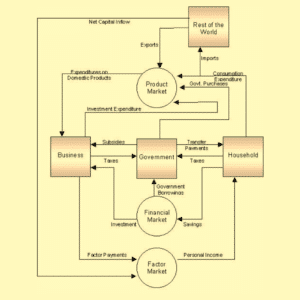
Three-Sector: Add government (taxes, spending).
-
Four-Sector: Add foreign trade (exports, imports).
-
Five-Sector: Include financial institutions (banks, stock market).
-
The circular flow illustrates the interconnectedness of the economy — money spent by one person becomes income for another.
Diagram:
1) Two-Sector Circular Flow

2) Three-Sector Circular Flow

3) Four-Sector Circular Flow

Key Takeaways
-
The economy works like a circle of give-and-take between households and firms.
-
Money flows in one direction, while goods and services flow in the other.
-
Adding government, banks, and foreign trade makes the model more realistic.
-
It highlights interdependence — one person’s spending is another person’s income.
Real-World Case
U.S. Stimulus Checks (2020 Pandemic)
-
The government gave households direct payments.
-
Households spent more at firms (retail, online).
-
Firms earned higher revenues and paid more wages.
-
This demonstrated the circular flow in action — injections boosted incomes, leading to higher output.