
Basic Economic Problems (What, How, For Whom)
Definition (Primary-Source)
Lionel Robbins (1932) defined economics as:
“Economics is the science which studies human behaviour as a relationship between ends and scarce means which have alternative uses.”
From this flows the basic economic problem: deciding what to produce, how to produce it, and for whom to produce it with limited resources.
Introduction
Every society, whether capitalist, socialist, or mixed, faces the same three big questions:
-
What to produce? (Guns or butter? Rice or smartphones?)
-
How to produce? (Labour-intensive or capital-intensive methods?)
-
For whom to produce? (Should goods go mainly to the rich, the poor, or be shared equally?)
These are called the basic economic problems because scarcity forces us to make choices.
Explanation
-
What to produce?
-
Every economy has limited land, labour, and capital. Choosing more of one good means less of another.
-
-
How to produce?
-
A country must decide between labour-heavy (human workers) or capital-heavy (machines) methods.
-
Example: India may rely more on labor-intensive methods, while the US relies more on technology-intensive ones.
-
-
For whom to produce?
-
Distribution depends on the economic system.
-
Capitalism: based on purchasing power.
-
Socialism: based on need and equality.
-
Mixed economies: a blend of both.
-
-
In short: Scarcity → Choice → These 3 problems.
Diagram: The Triangle of Basic Economic Problems
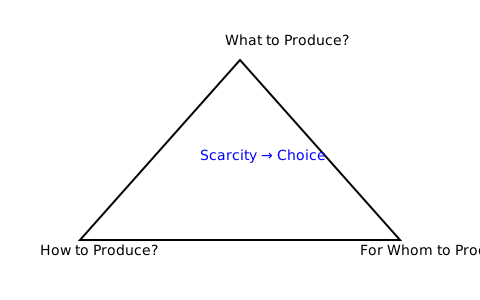
Diagram Explanation
The triangle represents the three fundamental questions. At the centre is scarcity, which drives the need for choice. Every society responds to these challenges differently, depending on its values, resources, and political systems.
Key Takeaways
-
Scarcity forces societies to confront three questions: what, how, for whom.
-
The answers vary depending on whether the economy is capitalist, socialist, or mixed.
-
Efficient allocation of resources requires constant trade-offs.
-
This is the foundation of all economic systems.
Real-World Case
India’s Green Revolution (1960s–70s)
-
What to produce? India prioritized food grains (wheat, rice) to fight famine.
-
How to produce? Shift from traditional farming to high-yield seeds, irrigation, and fertilizers.
-
For whom to produce? Initially, benefited farmers with land and access to technology; later, it spread to a wider consumer base through government distribution.