
Elasticity of Supply
Definition
Alfred Marshall, in Principles of Economics (1890), defined elasticity of supply as the responsiveness of quantity supplied to a change in price. In symbols: Es = (% change in Qs) ÷ (% change in P).
Marshall, Alfred. Principles of Economics:
Introduction
Think of a bakery. If the market price for croissants rises, how quickly can the bakery produce more? With spare ovens and dough ready, supply responds a lot (elastic). With every oven already at maximum capacity, the response is minimal (inelastic). Elasticity of supply tells us how quickly and how much producers can adjust output when the price changes.
Explanation
• Measure and interpretation
– Es > 1: Elastic supply (quantity supplied responds more than proportionately to price).
– Es = 1: Unitary elastic.
– Es < 1: Inelastic supply (quantity supplied responds less than proportionately).
– Special cases: perfectly inelastic (Es = 0), perfectly elastic (Es → ∞).
• Why supply elasticity differs across industries
- Time horizon: The Short run is usually less elastic; the long run is more elastic as firms add capacity.
- Spare capacity: Idle machines/workers make it easier to ramp up output (higher Es).
- Factor mobility and input availability: If skilled labor or key inputs are easily obtainable, Es rises.
- Production lags: Long crop cycles or complex manufacturing lower short-run Es.
- Storage and perishability: Storable goods (e.g., steel coils) have a more elastic supply than perishables.
- Entry and exit: Fewer barriers to entry → more elastic industry supply.
• Manager/policy checklist
– Use promotions only if your supply can expand (elastic) to meet demand.
– For volatile goods, plan around short-run inelasticity to avoid stockouts or gluts.
– Invest in capacity, logistics, and supplier depth to raise elasticity over time.
Diagram
-
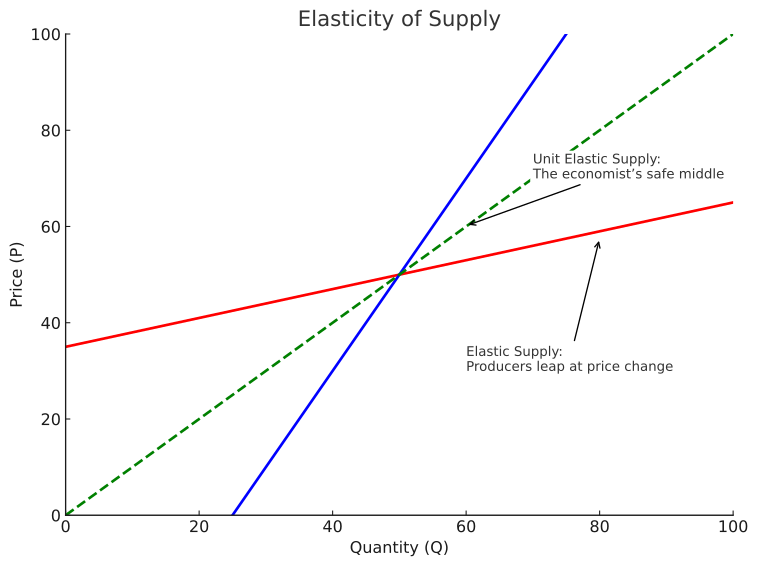
Elastic Supply (red, flatter) → Producers are basically on caffeine: price rises a bit, and suddenly output floods the market.
-
Inelastic Supply (blue, steep) → Producers shrug: “Raise prices all you want, buddy, we can’t crank out more oil overnight.”
-
Unit Elastic (green dashed) → The economist’s favorite middle child: nice, tidy, and conveniently textbook-perfect — which, of course, means it barely exists in reality.
Real-World Case
Fresh vegetables vs. processed foods
In many Indian cities, a sudden price rise for a fresh vegetable (e.g., tomatoes) meets low short-run Es because farmers can’t instantly grow more—prices spike. By the following season, acreage adjusts and supply becomes more elastic, easing prices. Processed or storable foods (such as packaged atta or rice) exhibit higher short-run elasticity because inventories can be released and production lines scaled up or down more quickly.
OECD Glossary, “Elasticity (supply and demand)
Key Takeaways
• Elasticity of supply measures how strongly the quantity supplied responds to price changes.
• Short run: typically inelastic; long run: more elastic as capacity adjusts.
• Determinants include spare capacity, factor mobility, production lags, storage, and entry barriers.
• Raising operational flexibility increases elasticity—and your ability to capture price opportunities.